Posts

Showing posts with the label World Bank

Emerging economies to double population by 2030
Image
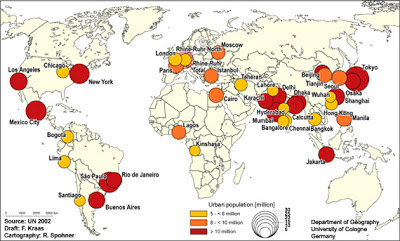
Developing countries are urbanizing fast. To meet the challenges that creates, city leaders must move quickly to plan, connect, and finance resilient and sustainable growth. A new World Bank report provides a framework to help. Today’s developed countries urbanized mostly gradually, their cities expanding over a period of 100 years or more as jobs shifted from farms to factories. The pace allowed for trial and error in growth patterns and policies. Developing countries today don’t have that luxury. They’re facing rapid migration that will tilt some populations from less than 20 percent urban today to more than 60 percent in just 30 years. City leaders must figure out now how they will provide the affordable homes, transportation, jobs, and basic infrastructure and services necessary to support already ballooning urban populations, do so with the least impact on the environment and prepare for increasing vulnerabilities stemming from climate change. A new World Bank report, Pla...

Asia-Pacific growth slows down in 2012

Image
 Growth in the East Asia and Pacific region slowed to an estimated 7.5 percent in 2012, from 8.3 percent in 2011, largely due to weak external demand and policy actions in China to contain inflation. Growth in the region, excluding China, slowed less quickly due to robust domestic demand. Economic activity throughout the region accelerated toward the end of the year as global financial markets stabilized and policies in China became more accommodative. Regional GDP growth is projected to pick up to 7.9 percent in 2013 before stabilizing at around 7.5 percent by 2015, with China’s economy expanding at 8.4 percent in 2013, before easing to 7.9 percent by 2015. Ex-China, regional growth is forecast to average 5.9 percent over 2013-2015 on strong domestic demand and intensified global trade flows. GDP growth in Europe and Central Asia is estimated to have slowed sharply to 3 percent in 2012 from 5.5 percent in 2011 as the region faced significant headwinds, including weak external dem...

Growth to slow in East Asia and Pacific this year

Image
Economic growth in the East Asia and Pacific region may slow down by a full percentage point from 8.2 percent in 2011 to 7.2 percent this year, before recovering to 7.6 percent in 2013. Growth in developed countries will remain modest, with recovery in the region to be driven mainly by strong domestic demand in developing countries, said the World Bank in its East Asia and Pacific Economic Data Monitor, released today. The new report says that weak exports and lower investment growth will cut down China's GDP growth from 9.2 percent in 2011 to 7.7 percent this year. In 2013, however, China's growth is expected to rebound to 8.1 percent as the impact of stimulus measures kicks in, supported further by an uptick in global trade. "The East Asia and Pacific region's share in the global economy has tripled in the last two decades, from 6 percent to almost 18 percent today, which underscores the critical importance of this region's continued growth for the rest of the wo...

Development banks expand funds for sustainable development projects

Image
Oil refineries emit heavy smokes. Investments in sustainable development projects worldwide have been the focus of discussions by six multilateral development banks (MDBs) at the Rio+20 summit in Rio de Janeiro, Brazil. Currently, total investments for sustainable development project totals $93 billion annually, and the six MDBs have expressed interest to expand their investments in support of global development priorities that are expected to be agreed upon at this week's Rio+20 summit meeting in Brazil, a press statement from the ADB said. According to Bindu Lohani, ADB's vice president for knowledge management and sustainable development, one of the greatest challenges facing developing countries is how to find ways to promote growth that will address the negative impacts of climate change, food security and water scarcity while at the same time, eradicating poverty. "Working together is the best way for multilateral development banks to leverage funds, technology ...

WB urges nations to fight illegal logging

Image
WASHINGTON, D.C.– Every two seconds, an area of forest the size of a football field is clear-cut by illegal loggers around the globe. A new World Bank report released Tuesday shows how countries can effectively fight illegal logging through the criminal justice system, punish organized crime, and trace and confiscate illegal logging profits. The report, Justice for Forests: Improving Criminal Justice Efforts to Combat Illegal Logging, says that to be effective, law enforcement needs to look past low-level criminals and look at where the profits from illegal logging go. By following the money trail, and using tools developed in more than 170 countries to go after =dirty money,‘ criminal justice can pursue criminal organizations engaged in large-scale illegal logging and confiscate ill-gotten gains. The World Bank estimates that illegal logging in some countries accounts for as much as 90 percent of all logging and generates approximately US$10–15 billion annually in criminal proc...

Wolfowitz: A victim of organizational politics?

Image
Wolfowitz: A victim of organizational politics? Nobody can tell how Paul Wolfowitz felt when he stepped down as president of the World Bank. Perhaps, some critics inside the World Bank are overjoyed that he had finally succumbed to pressures. As gleaned, Mr. Wolfowitz did his best to resist these pressures but trying to atone for his misdeeds, but to no avail. Of course, the culprits are his girlfriend and the unique management style and strategies that he introduced when he took over the bank post. Management studies showed that it is not always healthful and helpful for an executive to bring with him a baggage of trusted men because nobody can tell what they have in their minds. Although, this is not always the case. But in most instances, these trusted individuals tend to create an atmosphere that appears to be unwelcome to others, especially those involved in policy-making decisions inside the organizations. Criticism is just part and parcel of someone who is at the top. No doubt a...