Posts

Showing posts with the label environment

Cheaper alternative solutions to stormy waves
Image
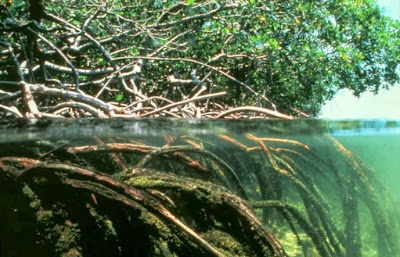
A mangrove swamp. Photo: Wikipedia Will mangroves be an effective barrier against onslaught of  stormy waves? In the aftermath of widespread destruction in Eastern Visayas brought about by super typhoon Yolanda last Nov. 8, 2013, the Department of Environment and Natural Resources (DENR) was immediately tasked to come out with an effective plan to at least mitigate the negative impacts of super typhoons upon the coastal areas in the areas devastated by the recent calamity . The DENR's task at hand seems to be a gargantuan feat that needs extra-cautious attention from those who are supposed to undertake the project. The topic I'm referring to revolves around a scheme that will identify coastal areas facing the Pacific Ocean to be planted with mangroves. According to Wikipedia, "mangroves are various types of trees up to medium height and shrubs that grow in saline coastal sediment habitats in the tropics and subtropics – mainly between latitudes 25° N and 25° S. T...
200 researchers to explore Papua New Guinea's biodiversity

Image
How many species live on Earth? The answer to this question probably resides in the study of biodiversity hotspots. Six years after the Santo expedition in Vanuatu, and 2 years after the Mozambique-Madagascar expedition, scientists are once again embarking on a voyage of discovery to learn about our planet's biodiversity. Led by France's National Museum of Natural History, Pro-Natura International and the French Institut de recherche pour le developpement (IRD), the expedition team will spend 3 months exploring Papua New Guinea , beginning in October 2012. From the Bismarck Sea to the slopes of Mount Wilhelm, the Papua New Guinea expedition will see off nearly 200 researchers, students and volunteers. Land expedition: the objective is to gather new data on plant and animal species distribution in the Mount Wilhelm's forests, from sea level to the tree line (altitude of about 4,000 metres). Marine expedition: the objective is to document the specific composition o...

Africa needs engineers and doctors

Image
Africa needs engineers as much as doctors to stop people dying needlessly, according to the South African entrepreneur Ivor Ichikowitz. The industrialist says so many more people will survive if sanitation is made more effective, clean water better transported and other projects better maintained - that the importance of engineers to Africa should be put on a par with medical staff. Ivor Ichikowitz is the founder of Paramount Group , Africa's largest privately owned defence and aerospace business, which employs 1,500 people, including hundreds of highly skilled engineers. He said: "Across Africa, poor sanitation systems and environmental defences consistently lead to people requiring medical support, particularly during floods and droughts.  "If we dedicated more engineers and investment to proactively tackling these problems in the first place then we could save many more lives across the continent and doctors could tackle other emergencies." According to ...

Scientists to tap 100% world's renewable energy by 2030

Image
Photo source: Wikipedia Scientists have advanced a plan to power 100% of the world's energy with wind, hydroelectric, and solar power by the year 2030. According to a 2011 projection by the International Energy Agency, solar power generators may produce most of the world’s electricity within 50 years, dramatically reducing the emissions of greenhouse gases that harm the environment. Cedric Philibert, senior analyst in the renewable energy division at the IEA said: “Photovoltaic and solar-thermal plants may meet most of the world’s demand for electricity by 2060 -- and half of all energy needs -- with wind, hydropower and biomass plants supplying much of the remaining generation”. “Photovoltaic and concentrated solar power together can become the major source of electricity,” Philibert said. Economic trends All forms of energy are expensive, but as time progresses, renewable energy generally gets cheaper, while fossil fuels generally get more expensive. A 2011 IEA report said: ...