Posts

Philippines gears up for big tremor
Image
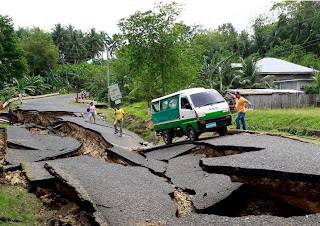
It's nice to hear that many people were spared from the wraths of a big tremor that hit eastern Visayas and a portion of Mindanao in the Philippines. However, the vestiges of cracks along the roads and some buildings in Samar Island, were testament to nature's fury. Volcanologists claimed the earthquake, measuring about 7.2 in the richter scale, took place in the deepest part of the Pacific Ocean. Had it occurred onshore, there's no doubt that it could have destroyed more buildings and other infrastructures. At this writing, people are still feeling the quake's aftershocks, and they have expressed fear that a tsunami might come next. According to Wikipedia, the Philippines lies within the Pacific Ring of Fire, which causes the country to have frequent seismic and volcanic activity. The Philippine Institute of Volcanology and Seismology (PHIVOLCS) said the earthquake was caused by movement on a previously undiscovered fault. Although this was already discovered...

Suicide bombers vs allied forces

Image
A Taliban tries to shoot a woman in the head for adultery. A suicide bomber struck again. This had resulted to the death of at least 25 innocent people during a funeral procession in eastern Afghanistan. This took place after the Talibans had succeeded in series of bombings that killed a lot of people in the past. In their desperate attempts to get back at the allied forces, in partnership with Afghan forces, the Talibans have been using suicide bombers to retaliate and kill other people in the name of their religious ideology. The Talibans always wanted to convert Afghanistan into a purely Islamic country, where advancement in education, and women whose faces are not covered by a veil, are considered mortal sins. To them, these practices are against the teachings of the Holy Koran, and where women are forced to obey their masters' greeds. However, the presence of the allied forces have made them inutile to implement what they wanted to be done in the ...

Monsoon rains subside, sun comes out

The non-stop torrential rains that brought Metro Manila to a standstill had slowly subsided, my relatives said. They said the sun has finally come out to shower the flooded streets with its golden rays. But for me, it isn't enough to dry up the surface and extinguish the fears that still grip most Filipinos whose households were submerged under water. All we could blame were the monsoon rains that continuously poured over most parts of central and northern Luzon areas. As weather officials said in a broadcast, there was no typhoon but a low pressure area far away from the Philippines.  The typhoon was headed to Taiwan and Mainland China, where some 250,000 were already affected as the typhoon made a landfall, a newswires agency said. Accordingly, people have started picking up the pieces. In some areas in Marikina City, where most of the barangays were heavily inundated, many of the displaced residents begin returning to their homes. "I'm sure, there will be a lot ...

Heavy rains flood Luzon Island

Image
My worst fear came on Tuesday when heavy rains continuously pounded most parts of central and northern Luzon in the Philippines. Hence, heavy flooding had paralyzed Metro Manila and other outlying areas. Consequently, the national government had ordered the suspension of classes in all levels and workers in public and the private sectors were instructed to go home. Likewise, many vehicles were stuck along the roads and highways. Many people were stranded as the vehicles they're riding got stuck along the flooded highways. Weather officials said the situation was a repeat of a strong typhoon named "Ondoy"  which hit the country in 2009. Surprisingly, the heavy rains were not brought by any  typhoon at all. Instead, there was another typhoon that was spotted very far from the Philippines' area of responsibility. But it's already closing in on Taiwan, weather officials said. The Philippines Weather Bureau confirmed in a broadcast invterview that  the heavy do...

Asean fails to agree over the Spratly dispute

Image
It's frustrating to know that nothing really happened after foreign ministers of the Association of Southeast Asian Nations failed to approve a substantial communique that would, once and for all, resolve the controversy that now hounds the contested territories in the South China Sea. Consequently, claimant countries like the Philippines, Brunei, Vietnam, Malaysia have expressed apprehensions as to the way the Chinese government behaves in so far as China's muscle-flexing in the disputed territories is concerned. What I learned is that Cambodia seemed unwilling to cooperate with what the other Asean members wanted in the first place--to form a European-style economic block by 2015. The intention was to show China what the Asean block could do to level the playing field in the northeast part of the South China Sea. While the controversy remains unresolved, "intense nationalist feelings around the region" are believed to be making it more difficult fo...

The rise of Chinese travellers

HONG KONG-- The number of Chinese travellers making international trips was up by a strong 22 per cent[1] in 2011, compared to 2010, and experts predict China is on track to overtake Germany and the US as the world's largest outbound tourism market in the next few years[2]. Launched today, the inaugural Chinese International Travel Monitor[3](CITM) from Hotels.com [http://www.hotels.com ](R), one of the world's leading online hotel booking websites, gives an insight into how the rise of the Chinese traveller is changing the dynamics of the global hotel market. Johan Svanstrom, Managing Director of Hotels.com Asia Pacific, commented: "The Chinese made a staggering 70 million[4] international trips in 2011 and, while many of these were to Hong Kong and Macau, the number going further afield is growing significantly. Implementing strategies to cater specifically to this burgeoning source market is moving from a nice-to-have to a competitive necessity." Surveying mo...

Eurozone crisis dampens Asia's growth

BANGKOK--Europe’s worsening financial and banking crisis and a sluggish recovery in the United States are weighing on developing Asia’s growth prospects, according to figures released today from the Asian Development Outlook Supplement (ADOS), published by the Asian Development Bank (ADB). “Economic growth in developing Asia moderated during the first half of 2012 as slower growth in the US and euro area reduced demand for the region’s exports,” the report says. “Worries over the economic strength of important developing economies have also emerged recently.” ADB’s latest figures predict developing Asia will expand by 6.6% in 2012 and 7.1% in 2013, lower than the 6.9% and 7.3% forecast in ADB’s Asian Development Outlook published in April. In addition to the impact of Europe’s malaise, the region’s development in the first half of the year has been hampered by slower growth in the two largest economies—the People’s Republic of China (PRC...