Posts

Scrapping of pork barrel funds untimely

Image
Supreme Court of the Philippines The latest Supreme Court's ruling that declared the Priority Development Assistance Fund (PDAF), also more popularly known as the "pork barrel funds",unconstitutional was unexpected. At this time, when the Philippines is faced with the on-going problem on massive rehabilitation and rebuilding of the infrastructures damaged by the strongest super typhoon Yolanda (international name: Haiyan) that ever hit the Philippines, the government will surely be rendered helpless in carrying out its mission to fast-track whatever it has started to normalize the grim situation in Tacloban City and the outlying towns and villages in Eastern Visayas. As of press time, the Camp Aguinaldo-based National Disaster Risk Reduction Management Council (NDRRMC) has confirmed the death toll at 4,011, with more than 18,000 injured and more than a thousand people still missing. In fact, the magnitude of destruction brought by Yolanda in Central Visayas was mu...

Media personalities at odds in typhoon coverage; relief goods distribution goes on

Image
Big waves  put this ship in the midst of ruins. ABS-BCN anchor and radio commentator Korina Sanchez  had reacted negatively to the reports  of CNN reporter Anderson Cooper who witnessed the extensive devastation on the ground while covering and interviewing victims of the recent super typhoon that flattened out most parts of Easter Visayas as it made a landfall in Guian, Eastern Samar, Philippines,  six days ago. In a report at the www.inquirer.net, it described Sanchez, the wife of the current Philippines Interior and Local Government Secretary Mar Roxas, as saying: "This Anderson Cooper, he said there is no government presence in Tacloban City. It seems he doesn't know what he is saying." The Inquirer reported that Cooper was actually covering what's happening on the grounds in Tacloban City where he talked to several victims of the super typhoon "Yolanda" as it flattened almost everything in its way as it exited to the direction of Vietnam. And ...

U.S. visitors with strange last names must be scrutinized closely

In the wake of the Boston marathon bombing, immigrants and tourists alike, especially those whose last names in their passports appear strange should be closely scrutinized before they are authorized to enter the United States. Why is this so? The federal government wants to ensure that that those who are allowed to visit America will not sow chaos and violence during their stay in the American soil. The first time the U.S. federal government had tightened screening of individuals entering the United States borders and ports took place after the 9-11 incident which killed at least 3,000 people when terrorists crashed two commercial airliners onto the Twin Towers in New York City. Could the two bombing suspects planned the bombing a long time ago as part of their mission? Nobody can tell at this point in time. And while the younger suspect is still recuperating and not talking in a Boston hospital, extracting those bits of information that are vital in finding out the bombers...

Emerging economies to double population by 2030

Image
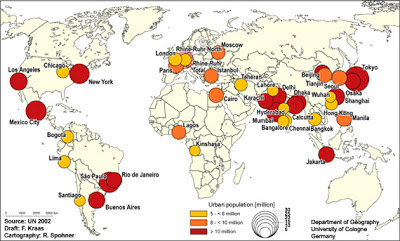
Developing countries are urbanizing fast. To meet the challenges that creates, city leaders must move quickly to plan, connect, and finance resilient and sustainable growth. A new World Bank report provides a framework to help. Today’s developed countries urbanized mostly gradually, their cities expanding over a period of 100 years or more as jobs shifted from farms to factories. The pace allowed for trial and error in growth patterns and policies. Developing countries today don’t have that luxury. They’re facing rapid migration that will tilt some populations from less than 20 percent urban today to more than 60 percent in just 30 years. City leaders must figure out now how they will provide the affordable homes, transportation, jobs, and basic infrastructure and services necessary to support already ballooning urban populations, do so with the least impact on the environment and prepare for increasing vulnerabilities stemming from climate change. A new World Bank report, Pla...

Asia-Pacific growth slows down in 2012

Image
 Growth in the East Asia and Pacific region slowed to an estimated 7.5 percent in 2012, from 8.3 percent in 2011, largely due to weak external demand and policy actions in China to contain inflation. Growth in the region, excluding China, slowed less quickly due to robust domestic demand. Economic activity throughout the region accelerated toward the end of the year as global financial markets stabilized and policies in China became more accommodative. Regional GDP growth is projected to pick up to 7.9 percent in 2013 before stabilizing at around 7.5 percent by 2015, with China’s economy expanding at 8.4 percent in 2013, before easing to 7.9 percent by 2015. Ex-China, regional growth is forecast to average 5.9 percent over 2013-2015 on strong domestic demand and intensified global trade flows. GDP growth in Europe and Central Asia is estimated to have slowed sharply to 3 percent in 2012 from 5.5 percent in 2011 as the region faced significant headwinds, including weak external dem...

Norway tops per capita income; China's GDP at 8.6%

Image
The Economist Intelligence Unit released in its latest survey of the world's GDP growth forecast for 2013 vis-a-vis the countries' per capita income. In the Asia-Pacific Countries, China is the leader of the pack with a growth forecast of 8.6% for 2013. Due to its large population, however,  its per capita income remains at $6,890. Sri Lanka (formerly Ceylon) comes second with 6.8%, with a per capita of $3,150. Others include Uzbekistan--6.7% ($1,920) ; India--6.5%($1,770); Afghanistan--6.5%($668); Indonesia--6.3% ($,3,890); Bangladesh--6.1% ($695); Philippines--6.0% ($2,650); Vietnam--6.0%  ($1,800); Kazakstan--5.1% ($12,210); Thailand--4.7%  ($5,800); Malaysia--4.6% ($11,580); Singapore--4.0% ($53,370); Hong Kong--2.4% ($35,610); Japan--1.2%  ($45,680); South Korea--3.7% ($24,590); Taiwan--3.6% ($22,020); Pakistan--3.3% ($1,410); New Zealand--2.3%  ($33,160); and Australia--3.0% with a per capita pegged at $66,950, the highest in the region so far. ...

US-based Chinese scientist files suit vs Nobel Assembly for unfair competition

Image
LOS ANGELES, Dec. 7, 2012 --Dr. Rongxiang Xu, the founder of "human body regenerative restoration science" and a renowned life scientist and medical scientist, has filed a lawsuit today against The Nobel Assembly at Karolinska Institutet, a Swedish corporation, aka, Nobelforsamlingen. The Nobel Assembly at Karolinska Institutet is a body which awards the Nobel Prize in Physiology or Medicine. The suit filed in Superior Court of the State of California, Orange County Central Justice Center cites Libel and unfair competition. Dr. Xu, one of the leading scientists in the world, discovered in 1984 the existence of "regenerative cell" which was confirmed to be keratin-19 positive stem cell after 2000 (US patent 6991813B2), during his study of burn treatments that has benefited 20 million burn victims in 73 countries, claims his good reputation in the community was defamed by a statement published by defendants, The Nobel Assembly, causing damages to Dr. Xu by their...